
Changes in Ambient Dose Rates in Forests
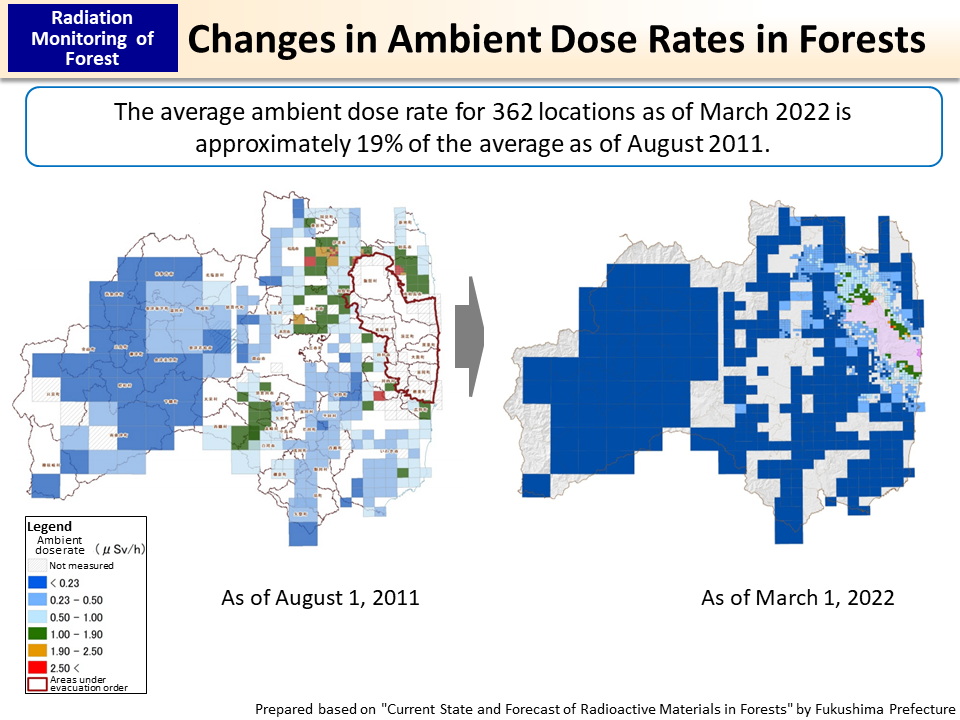
Fukushima Prefecture has been conducting monitoring of ambient dose rates in forests within the prefecture every year since FY2011. The monitoring targeted 362 locations in FY2011 but gradually expanded the coverage to target 1,316 locations in FY2023.
For the 362 locations, where monitoring has been continued from the beginning, the average ambient dose rate for FY2023 was 0.17 μSv/h, the same level as for FY2022, which was approximately 19% of the average as of August 2011 (0.91 μSv/h). As of March 2024, the number of areas where the ambient dose rate was less than 0.23 μSv/h increased to 265 (73%) from 42 (12%) in FY2011. In the meantime, the number of areas where the ambient dose rate was 1.00 μSv/h or more decreased gradually from 127 (35%) in FY2011, and there has been none since FY2020.The ambient dose rate in forests has decreased almost the same as the decrease in dose rate due to physical attenuation.
Measurement results by region as of March 2024 (minimum value - maximum value) are as follows.
- Ken-poku (northern pref.) (361 locations): 0.04 - 1.03 μSv/h
- Ken-chu (central pref.) (122 locations): 0.04 - 0.37 μSv/h
- Ken-nan (southern pref.) (38 locations): 0.04 - 0.20 μSv/h
- Aizu (33 locations): 0.03 - 0.08 μSv/h
- Minamiaizu (22 locations): 0.03 - 0.08 μSv/h
- Soso (669 locations): 0.09 - 2.62 μSv/h
- Iwaki (71 locations): 0.04 - 0.86 μSv/h
(Related to p.186 of Vol. 1, “Distribution of Radioactive Materials in Forests”)
- Included in this reference material on March 31, 2019
- Updated on March 31, 2025