

Press Release
December 19, 2025
- Global Environment
Outcome of “Business Forum on JCM Project Matchmaking and Advancing Article 6 Implementation in Bangladesh” Held in Dhaka, Bangladesh
1. The Ministry of the Environment (MoE) of Japan, together with the Department of Environment, Ministry of Environment, Forestry and Climate Change of Bangladesh, hosted a business forum titled:
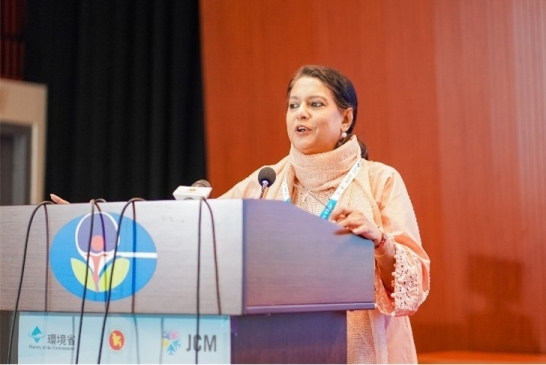
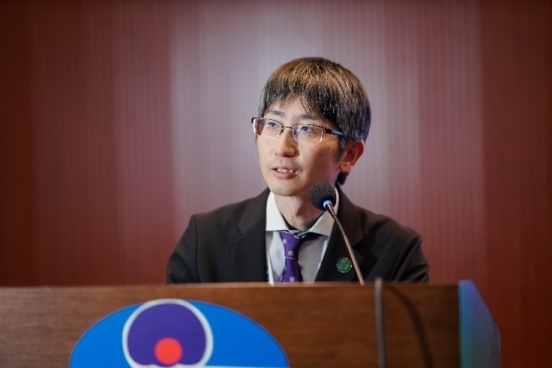
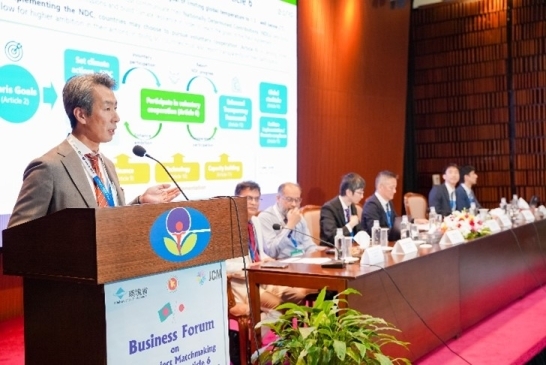
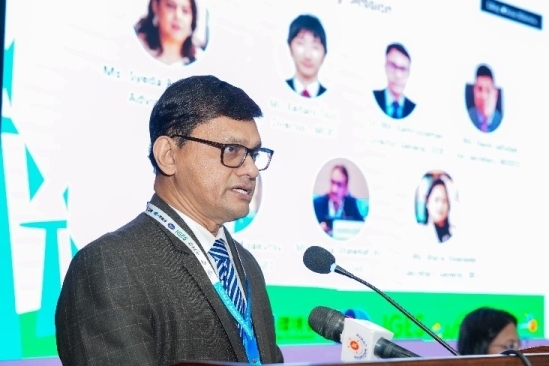
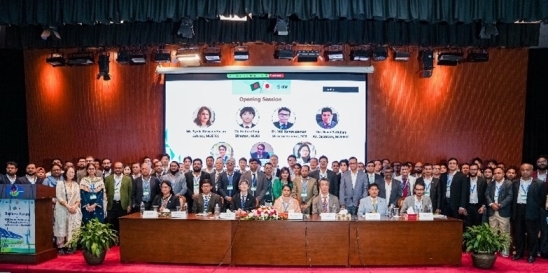
“Business Forum on JCM Project Matchmaking and Advancing Article 6 Implementation in Bangladesh” held in Dhaka, Bangladesh on December 7, 2025.
2. The Forum highlighted the Joint Crediting Mechanism (JCM) as a practical bilateral cooperation approach for the simultaneous implementation of Article 6 of the Paris Agreement and Nationally Determined Contributions (NDCs). It promoted business engagement and JCM project matchmaking for carbon markets in Bangladesh, with the aim of strengthening practical understanding of Article 6 through the development of JCM projects in the country. The Forum brought together a diverse group of stakeholders from Japan and Bangladesh to explore opportunities for business collaboration in JCM project development and to facilitate meaningful matchmaking among potential partners.
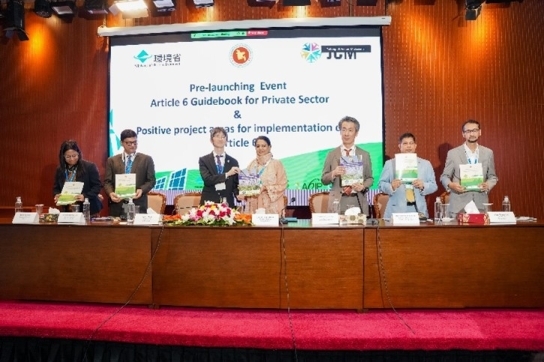
The Forum provided a platform for pre-launching of “A guidebook for the Private Sector on Implementation of Article 6” and “the positive project area lists for Article 6 implementation”, which has been developed under the Capacity building Support Package of the A6IP to Bangladesh. These documents serve as a practical reference to support private sector stakeholders in understanding and engaging in carbon market activities under Article 6 of the Paris Agreement.
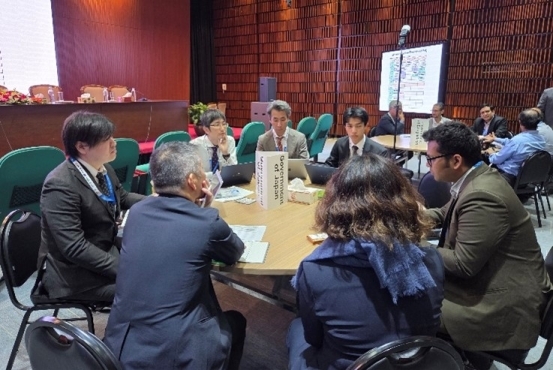
3. During the business pitch session, four Japanese and Bangladesh companies presented a wide range of technology-based and nature-based project concepts, including Agrivoltaics, Nature based Solution, Wasted to Energy, and Alternate Wetting and Drying (AWD). In the subsequent business matching session, the four companies and one regional development bank and government representatives from both countries engaged in individual discussions with stakeholders from Japan, Bangladesh, and India to explore the potential for JCM project development.
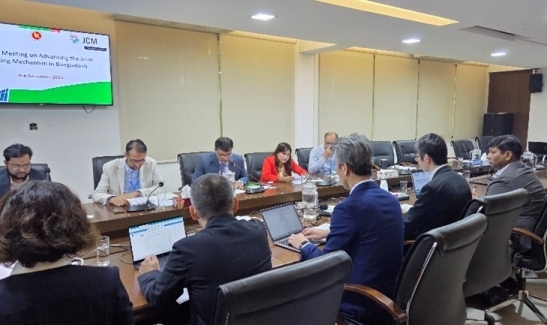
4. On the following day (December 8, 2025), a bilateral meeting was held with the Ministry of Environment, Forest and Climate Change of Bangladesh to discuss key issues related to the Joint Crediting Mechanism (JCM). In addition to the bilateral meeting, several consultations were conducted between the two governments and companies involved in, or considering, the development of JCM projects, with the aim of addressing existing challenges and exploring feasible solutions.
5. MOE Japan will continue to promote the expansion and acceleration of JCM utilization, contributing to Bangladesh’s decarbonization efforts.
■ Overview of the Business Forum on JCM Project Matchmaking and Advancing Article 6 Implementation in Bangladesh
Date and Time: December 7, 2025, 10:00–18:00 (Bangladesh time)
Venue: Department of Environment (DoE), Dhaka, Bangladesh
Format: Hybrid (In-person and online)
Organizers
● Ministry of the Environment (MOE), Japan
● Department of Environment, Ministry of Environment, Forestry and Climate Change, Bangladesh
Co-Organizers
● Institute for Global Environmental Strategies (IGES) / Paris Agreement Article 6 Implementation Partnership (A6IP) Center
● Overseas Environmental Cooperation Center, Japan (OECC)
● JCM Implementation Agency (JCMA)
Partner Organizations:
● Japan-Bangladesh Chamber of Commerce & Industry (JBCCI)
● Japan International Cooperation Agency (JICA) Bangladesh office
● The Japan External Trade Organization (JETRO) Dhaka Office
Participants: Approx. 170 (Approx.130 in-person)
Languages: English
Presentation Materials: Available here
■ Agenda:
| Time | Program | Speakers and Presenters |
| 9:30- | Participant registration | |
| Session1 | Opening of the Forum | |
| 10:00-10:05 | Welcome Remarks from DoE | Dr. Md. Kamruzzaman (ndc), Director General, DoE |
| 10:05-10:10 | Welcome Remarks from IGES | Mr. Kazuhisa Koakutsu, Director A6IP/IGES |
| 10:10-10:15 | Remarks from JBCCI | Ms. Maria Howlader, the Secretary General, JBCCI |
| 10:15-10:20 | A6 and JCM in Bangladesh | Mr. Mirza Shawkat Ali, Director (Climate Change and International Convention) DoE |
| 10:20-10:30 | Remarks from MoEJ | Mr. Keitaro Tsuji, Director JCM Office, MoEJ |
| 10:30-10:40 | Chief Guest Remarks from MoEFCC | Ms. Syeda Rizwana Hasan, Honorable Advisor, MoEFCC |
| 10:40-10:50 | Pre-launching of the Article 6 Guidebook for Private Sector, Positive project areas for implementation of Article 6 | MoEFCC-MoEJ-DoE-A6IP |
| 10:50-11:00 | Remarks of the chair | Mr. Mohammad Navid Safiullah, Additional Secretary, MoEFCC |
| 11:00-11:15 | Tea Break and Refreshment | |
| Session2 | JCM and Article 6 of the Paris Agreement | |
| 11:15-11:30 | Carbon Market Framework in Bangladesh | Md. Harun Or Rashid, Deputy Director (International Convention) Department of Environment (DoE) |
| 11:30-11:45 | Japan’s Approach to Article 6: The Role of the Joint Crediting Mechanism and Its Latest Progress | Keitaro Tsuji, Director of JCM Office, MoEJ |
| 11:45-11:55 | Rule of Implementation under JCM and Global Match | Mr. Satoru Mimura, JCM Implementation Agency (JCMA) |
| 11:55-12:05 | Article 6 of the Paris Agreement: Enabling International Carbon Markets and Cooperation | Mr. Kazuhisa Koakutsu, Director, A6IP/IGES |
| 12:05-12:15 | Introduction to ADB support for Carbon market fund for JCM | Mr. Shohei Okano, Environment and Carbon Market Specialist JFJCM Fund Manager Climate Change and Sustainable Development Department Asian Development Bank (ADB) |
| 12:15-12:25 | Carbon market instrument for advancing the Article 6 implementation | Mr. Keisuke Iyadomi, Senior Carbon Finance Specialist, World Bank |
| 12:25-12:50 | Interactive discussion (Q&A) | All Participants |
| 12:50-14:00 | Payer and Lunch Break | |
| Session3 | Key Sectors and Technologies for Implementation under Article 6.2 and the Joint Crediting Mechanism (JCM) | |
| 14:00-14:05 | Agrivoltaics: Developing a Sustainable Business Model for Agrivoltaics in Bangladesh: Progress and Insights | Dipal C. Barua Founder & Chirman, Bright Green Energy Foundation (BGEF) |
| 14:05-14:10 | Nature based solution: Bengal Blue Carbon Initiatives using NbS -Mangrove Afforestation for Protecting Coastal areas and Sequestration of GHG- | M. Samiun Nabi, Certified Climate Finance Expert, Head of SPB, Instiutte for Water Modeling (IWM) |
| 14:10-14:15 | Waste to Energy: Chattogram Waste-to-Energy Project: Leveraging JCM for Climate Action | Gen Takahashi, Deputy General Manager, Sales & Marketing Dept., Global Business Div., Environmental Solutions Sector, JFE Engineering Corporation |
| 14:15-14:20 | Alternate Wetting and Drying (AWD): Driving Agricultural Transformation with AWD and Digital Platforms -DX/GX Strategies through the JCM Pilot Program- | Shunsuke Miyake, Global Business Promotion Div. Manager, Ryobi Systems., Itd. |
| 14:20-14:30 | Summary and Closing | Dr. Bijon Kumer Mitra, Research Director (ISC), IGES Mr. Kazuhisa Koakutsu, Director, A6IP Mr. Dharitri Kumar Sarkar, Joint Secretary, MoEFCC |
| 14:30-14:50 | Coffee Break | |
| Session4 | Business Matchmaking | |
| 14:50-17:00 | Consultation: 15-minute slots × 8 slots x about 7 tables, where Bangladeshi Companies can directly interact with relevant agencies and Japanese companies. Note: Advance pre-registration is required for Bangladeshi companies | |
■ Overview of Business Pitch Presentations:
As part of the forum, four Japanese and Bangladeshi companies presented JCM-aligned project concepts, highlighting a range of technology-based and nature-based solutions with significant mitigation potential in Bangladesh. The presentations underscored the largely untapped opportunities for deploying JCM projects in Bangladesh through bilateral cooperation and private-sector engagement.
Technology-based Solutions:
1. Agrivoltaics by Bright Green Energy Foundation (BGEF), Bangladesh –
An agrivoltaic-based JCM project concept for Bangladesh was presented, highlighting its alignment with the Renewable Energy Policy 2025, which targets 20% renewable energy by 2030 and 30% by 2040. The initiative addresses land scarcity by combining solar power generation with agricultural activities, enabling dual land use for food and energy production. Drawing on successful agrivoltaic models in Japan, a 1 MW project concept was introduced, building on an ongoing pilot in Manikganj. The project aims to support local energy needs, promote inclusive agricultural growth, create jobs, and deliver social benefits such as community development and women’s empowerment. The project is expected to mitigate 854 tCO2/year.
2. Mangrove afforestation by Institute for Water Modeling (IWM), Bangladesh
A nature-based Blue Carbon initiative focused on mangrove afforestation was presented to protect Bangladesh’s coastal areas, enhance climate resilience, and sequester greenhouse gases. The project aims to restore 30,000 hectares of mangrove forests, with an estimated sequestration potential of 17 million tons of CO₂ over 20 years, while aligning with Bangladesh’s NDC3 commitments and the SDGs. Implemented through international and local collaboration, the initiative integrates community development by reinvesting carbon credit revenues into essential services such as clean water, healthcare, and education.
3. Waste to Energy by JFE Engineering, Japan –
A JCM-based waste-to-energy project concept for Chattogram City was presented, highlighting the urgent need to address the city’s daily generation of around 3,000 tons of waste and the associated environmental and public health challenges. The project aims to convert waste into clean electricity, reducing greenhouse gas emissions while improving waste management, drawing on a successful model implemented in Vietnam that generates 11.6 MW of power and cuts 42,000 tons of CO₂ annually. Leveraging proven experience in operational JCM waste-to-energy projects, the initiative seeks to reduce landfill emissions, displace fossil fuel–based electricity, and enhance economic viability through JCM financing. The project encourages collaboration with Bangladeshi public and private stakeholders to implement this climate and environmental solution.
4. Alternate Wetting and Drying in paddy field, Ryobi Systems, Japan
The Alternate Wetting and Drying (AWD) practice in paddy fields was presented as a sustainable agricultural approach that integrates efficient water management with digital technologies to enhance rice production and reduce emissions. The proposed JCM project concept plans to implement AWD across 5,600 hectares and is expected to achieve a 20% increase in yields and a 40% reduction in methane emissions. The AWD-based carbon credit model demonstrates strong potential for scaling up climate-smart and economically viable agricultural practices across Bangladesh.
■ Bilateral meeting and JCM Project Discussions with Companies from Both Countries:
On the following day (December 8, 2025), a bilateral meeting was held with the Ministry of Environment, Forest and Climate Change of Bangladesh to discuss key issues related to the Joint Crediting Mechanism (JCM). In addition to the bilateral meeting, several consultations were conducted between the two governments and companies involved in, or considering, the development of JCM projects, with the aim of addressing existing challenges and exploring feasible solutions.
Contact
Office for the Joint Crediting Mechanism and International Carbon Market, Global Environment Bureau, Ministry of the Environment, Japan
- Direct number
- +81-3-5521-8246
- jcm-contact@env.go.jp