
Indoor Radon
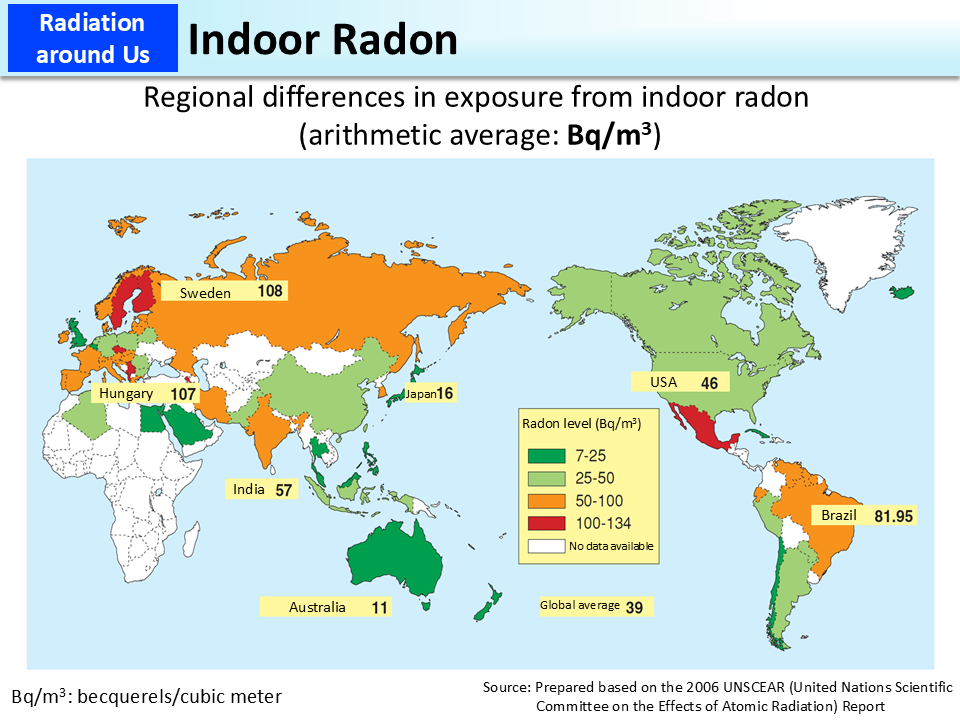
Radon is a radioactive noble gas produced by the alpha-decay of radium, which is universally present under the ground. Since radon is a chemically stable gas, it is emitted from the ground and seeps into houses (p.71 of Vol. 1, “Internal Exposure to Radon and Thoron through Inhalation”).
In areas where people live in masonry houses, such as Europe, indoor radon concentrations are high and exposure doses tend to be high as a result.
The global average of indoor radon concentrations is 39 Bq/m3, while Japan has an average value of 16 Bq/m3. There are also large regional differences in internal exposure doses from indoor radon.
International organizations, such as the World Health Organization, recommend taking some measures when the indoor radon concentration exceeds 100 Bq/m3 to 300 Bq/m3. Some countries are actually taking certain measures. See the following websites for details.
https://www.niph.go.jp/soshiki/09seikatsu/EMA/radiation/radon/radonindex.html (in Japanese)
https://www.who.int/publications/i/item/9789241547673
https://www.epa.gov/radon
https://eur-lex.europa.eu/legal-content/EN/TXT/PDF/?uri=OJ:L:2014:013:FULL
- Included in this reference material on March 31, 2013
- Updated on March 31, 2025