

Background Monitoring Survey for Atmospheric Mercury Concentration
FY2024 Results on Background Monitoring for Mercury in Atmosphere and Precipitation, and other Elements in Aerosols
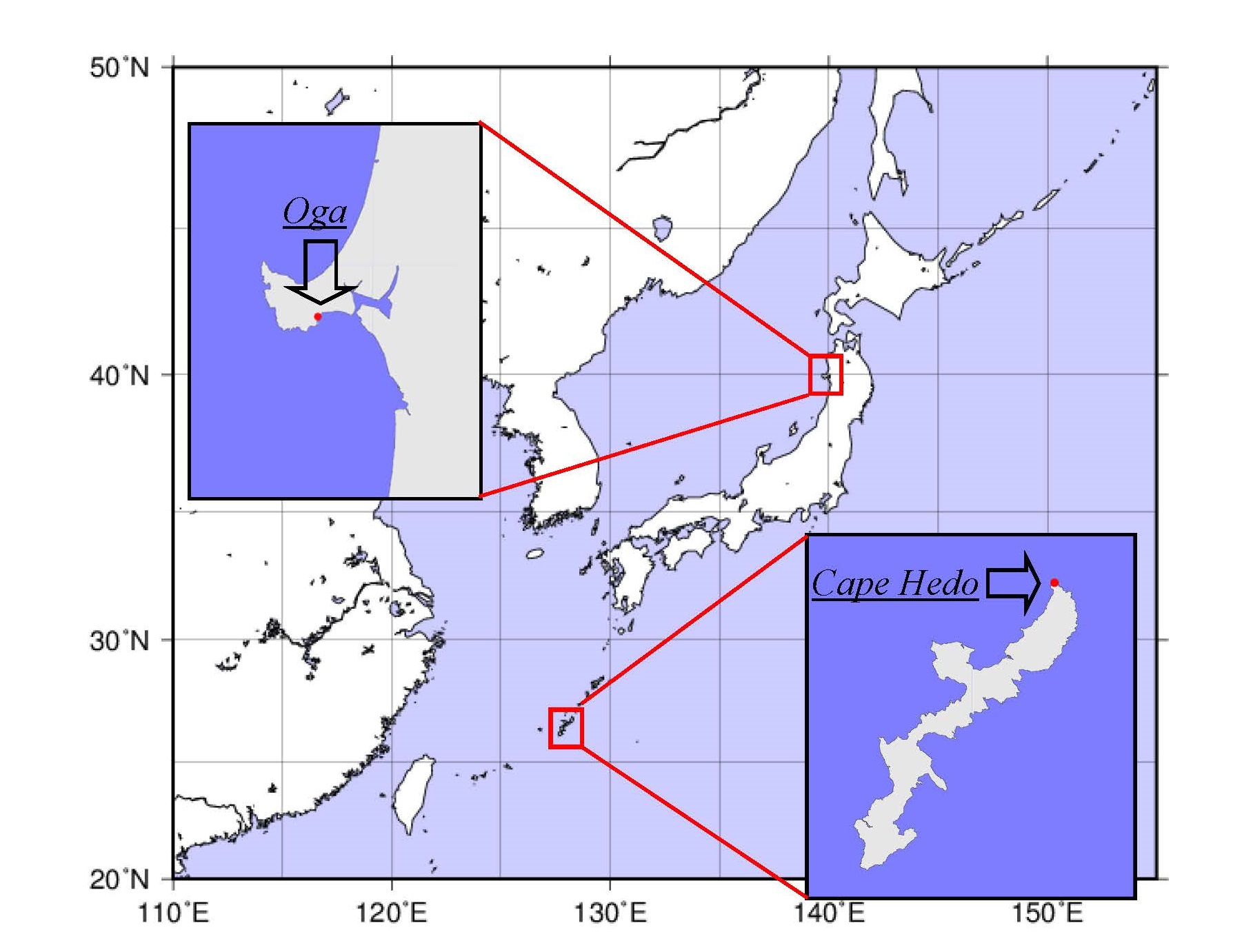
Ministry of the Environment, Government of Japan (MOEJ), has been conducting background monitoring for atmospheric mercury at Cape Hedo in Okinawa Prefecture (hereinafter referred to as Cape Hedo) and at Oga Peninsula in Akita Prefecture (hereinafter referred to as Oga), where direct effect from local emission sources is minimal.
The results of the survey in Fiscal Year (FY) 2024 (April 1st, 2024, through March 31st, 2025) indicated that mercury concentrations in atmosphere and precipitation at Cape Hedo and Oga were well below the national guideline values, and these values did not deviate significantly from those of the past survey results.
1. Overview of the Survey
MOEJ has been monitoring background concentrations of atmospheric mercury, namely Gaseous Elemental Mercury (GEM), Gaseous Oxidized Mercury (GOM), Particle Bound Mercury (PBM), and mercury deposited with precipitation at Cape Hedo and Oga.
In addition, 17 hazardous elements and six index elements were monitored at Cape Hedo to understand the source, fate and transportation of atmospheric mercury.
2. Summary of Survey Result
(1) Atmospheric Mercury Concentration
Annual mean concentrations of the sum of all mercury forms in the atmosphere in FY2024 were 1.6 ng/m3 at Cape Hedo and 1.6 ng/m3 at Oga, both of which were well below the guideline values for hazardous air pollutants to reduce health risks (i.e. 40 ng/m3 as annual mean value).
At both sites, GEM accounted for a large portion of mercury in the atmosphere (see Tables 1 and 2, and pages 6 and 12 of the attached document for detail.).
At Cape Hedo, annual mean concentrations of speciated mercury and total atmospheric mercury have remained at a constant level since FY2013 (see Table 1, and pages 8 and 9 of the attached document for detail).
At Oga, annual mean concentrations of speciated mercury and total atmospheric mercury have remained at a constant level since FY2014 (see Table 2, and pages 14 and 15 of the attached document for detail).
Table 1 Atmospheric mercury concentrations at Cape Hedo (annual mean)
(Unit:ng/m3) [1]
|
Measured |
FY2015 |
FY2016 |
FY2017 |
FY2018 |
FY2019 |
FY2020 |
FY2021 |
FY2022 |
FY2023 | FY2024 |
|---|---|---|---|---|---|---|---|---|---|---|
|
GEM |
1.6 |
1.7 |
1.6 |
1.6 |
1.7 |
1.7 |
1.7 |
1.6 | 1.6 | 1.6 |
|
GOM |
0.001 |
0.002 |
0.002 |
0.002 |
0.002 |
0.002 |
0.001 |
0.001 | 0.002 | 0.001 |
|
PBM |
0.002 |
0.003 |
0.002 |
0.002 |
0.002 |
0.002 |
0.002 |
0.002 | 0.002 | 0.002 |
|
Total |
1.7 |
1.7 |
1.6 |
1.6 |
1.7 |
1.7 |
1.7 |
1.6 | 1.6 | 1.6 |
[1] The concentrations of mercury and its compounds converted to the amount of mercury are shown. The same applies to Tables 2 and 3.
Note: for the measurement results before FY2015, please refer to the attached document "FY2024 Results on Background Monitoring for Mercury in Atmosphere and Precipitation, and other Elements in Aerosols".
Table 2 Atmospheric mercury concentrations at Oga (annual mean)
(Unit: ng/m3)
|
Measured |
FY2015 |
FY2016 |
FY2017 |
FY2018 |
FY2019 |
FY2020 |
FY2021 |
FY2022 | FY2023 | FY2024 |
|---|---|---|---|---|---|---|---|---|---|---|
|
GEM |
1.6 |
1.6 |
1.6 |
1.6 |
1.5 |
1.6 |
1.6 | 1.5 | 1.5 | 1.6 |
|
GOM |
0.003 |
0.002 |
0.003 |
0.003 |
0.002 |
0.003 |
0.003 | 0.003 | 0.002 | 0.002 |
|
PBM |
0.009 |
0.011 |
0.009 |
0.008 |
0.006 |
0.012 |
0.006 | 0.007 | 0.007 | 0.006 |
|
Total |
1.6 |
1.6 |
1.6 |
1.6 |
1.5 |
1.6 |
1.6 | 1.5 | 1.6 | 1.6 |
Note: for the measurement results before FY2015, please refer to the attached document "FY2024 Results on Background Monitoring for Mercury in Atmosphere and Precipitation, and other Elements in Aerosols".
(2) Mercury Concentration in Precipitation
The annual mean concentration of mercury in precipitation in FY2024 was 5.4 ng/L at Cape Hedo and 5.4 ng/L at Oga. The concentration was within the range of previous years at Cape Hedo and Oga (see Table 3, and pages 19 and 23 of the attached document for detail).
Table 3 Mercury concentrations in precipitation at Cape Hedo and Oga (annual mean)
(Unit: ng/L)
|
Monitoring site |
FY2017 |
FY2018 |
FY2019 |
FY2020 |
FY2021 |
FY2022 | FY2023 | FY2024 |
|---|---|---|---|---|---|---|---|---|
|
Cape Hedo |
4.8 |
3.9 |
5.6 |
5.0 |
5.3 | 5.4 | 4.0 | 5.4 |
|
Oga |
5.7 |
6.0 |
6.0 |
7.9 |
5.5 | 6.2 | 5.3 | 5.4 |
(3) Concentrations of Other Metal Elements in Aerosols
In FY2024, annual mean concentrations of chromium, manganese, nickel, arsenic, cadmium and lead in aerosols at Cape Hedo were 3.0 ng/m3, 2.3 ng/m3, 0.89 ng/m3, 0.56 ng/m3, 0.049 ng/m3 and 1.2 ng/m3, respectively (see Table 4). The concentrations of manganese, nickel and arsenic were significantly lower than the guideline values, for hazardous air pollutants to reduce health risks (guideline values as annual mean: manganese 140 ng/m3, nickel 25 ng/m3 and arsenic 6 ng/m3).
The annual mean concentrations of chromium, nickel and arsenic were within the range of previous years. Those of manganese, cadmium and lead were the lowest in the survey period so far.
Table 4 Metal element concentrations in aerosols at Cape Hedo (annual mean)
(Unit: ng/m3) [2]
| Measured item |
Guide-line value |
FY2015 | FY2016 | FY2017 | FY2018 | FY2019 | FY2020 | FY2021 | FY2022 | FY2023 | FY2024 |
|---|---|---|---|---|---|---|---|---|---|---|---|
|
Chromium |
- |
0.69 |
0.65 |
0.91 |
1.8 |
2.1 |
4.3 |
2.5 | 3.9 | 3.6 | 3.0 |
|
Manganese (Mn) |
140 |
3.7 |
2.9 |
4.0 |
4.9 |
3.7 |
4.2 |
3.0 | 2.9 | 3.8 | 2.3 |
|
Nickel |
25 |
1.1 |
0.74 |
0.98 |
0.97 |
0.86 |
1.0 |
0.76 | 0.90 | 1.1 | 0.89 |
|
Arsenic |
6 |
0.74 |
0.73 |
0.73 |
0.70 |
0.66 |
0.61 |
0.43 | 0.51 | 0.65 | 0.56 |
|
Cadmium |
- |
0.13 |
0.13 |
0.11 |
0.096 |
0.083 |
0.067 |
0.052 | 0.057 | 0.062 | 0.049 |
|
Lead |
- |
3.4 |
3.1 |
2.9 |
2.7 |
2.1 |
1.8 |
1.3 | 1.4 | 1.6 | 1.2 |
[2]The concentrations of each metal and its compounds converted to the amount of each metal are shown.
Note: "guideline value" denotes the "guideline values for hazardous air pollutants to reduce health risks" of Japan.
3. Future Action
MOEJ will continue this background mercury monitoring survey to contribute to grasp international mercury emissions and global trend of mercury concentration and their impact on the Japanese environment.
Under the supervision of experts, the results of this monitoring will continue to be published regularly.
Furthermore, in order to contribute to the effectiveness evaluation of the Minamata Convention on Mercury, we will provide the data of this monitoring widely and share internationally the technical knowledge accumulated to ensure accuracy and precision of measurement.
.
■ Appendix 1 Outline of monitoring sites
Outline of monitoring sites
|
Site |
Cape Hedo Atmosphere and Aerosol Monitoring Station:CHAAMS |
|---|---|
|
Address |
Naganehara 1000, Ginama, Kunigami-son, Kunigami-gun, Okinawa |
|
Location |
26.87°N, 128.25°E |
|
Overview |
CHAAMS is a monitoring station established and operated by the National Institute for Environmental Studies, Japan, for aerosols and gases monitoring in the atmosphere in order to investigate transboundary air pollution.
|
|
Site |
Oga Peninsula |
|---|---|
|
Address |
Izumidai 3-2, Funagawaminato-funagawa, Oga-shi, Akita |
|
Location |
39.89°N, 139.85°E |
|
Overview |
Oga Peninsula monitoring station was installed adjacently to Funakawa Ambient Air Pollution Monitoring Station operated by Akita Prefecture. |
■ Appendix 2 Sampling and analytical methods of different forms of mercury and other metal elements in atmosphere
|
Component
|
Measurement items |
Sampling and analytical |
Site |
|
|---|---|---|---|---|
|
Atmosphere |
Mercury |
Mercury forms |
Continuous measurement with Tekran® mercury speciation system |
Cape Hedo and Oga
|
|
Particulate |
17 hazardous elements |
7 days continuous sampling by using a low-volume sampler and analyzed by ICP/MS |
Cape |
|
|
6 index elements |
||||
| Precipitation | Mercury | Total Hg | Sampling by using an automatic wet-only sampler and analyzed by CVAAS (EPA method 1631, Revision E) | Cape Hedo and Oga |