

Nature & Parks
Nature Conservation in Japan -Section 5
[Policies & Program] Nature Conservation in Japan
5.Natural Park
5.1 Category
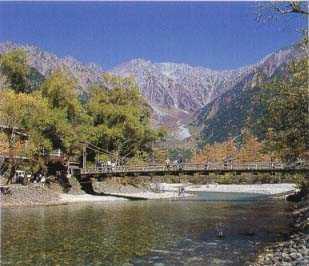
Kamikochi
(Chubu Sangaku National Park)
Legal basis of Natural Parks is the Natural Parks Law. The Law aims to conserve scenic areas and their ecosystems, to promote their utilization, and to contribute to the health, recreation and environmental education of the people. In compliance with this law, natural parks are categorized into the following 3 parks. National Parks: The place of greatest and national-level natural scenic beauty and ecosystems, worthy of the names of the national scenic and out-standing ecosystem's sites in Japan. Quasi-National Parks: The places of great natural scenic beauty at the district level, next to the level of National Parks. Prefectural Natural Parks: The places of prefectural-level importance and designated by the related prefectural governors.
[Policies & Program] Nature Conservation in Japan
5.Natural Park
5.2 Designation
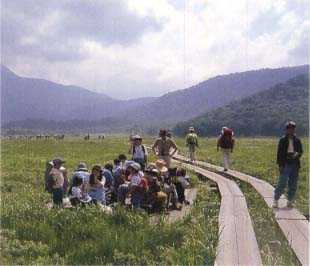
Ozegahara
(Nikko National Park)
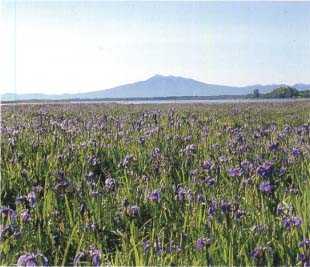
Abashiri
(Abashiri Quasi-national Park)
- National Park : Designated by the Director General of the Environment Agency after conferring with related governmental agencies and consulting with the Nature Conservation Council. 28 parks, 2.05 million hectares (ca. 5.4% of the area of the country)
- Quasi-National Park: Designated by the Director General of the Environment Agency by proposal of the related prefectural governors after conferring with related governmental agencies and consulting with the Nature Conservation Council. 55 parks, 1.33 million hectares (ca. 3.5% of the area of the country)
- Prefectural Natural Park : Designated by the prefectural governments in accordance with the prefectural ordinance. 301 parks, 1.94 million hectares (ca. 5.1% of the total area of the country)
Classification of Zones in National Parks, and Regulation on Activities
| National Park
The Classification of zones is decided in park conservation plan | Special Zone | Special protection zone | Areas required to maintain scenic beauty strictly | Erection of structures is prohibited in principle. |
|---|---|---|---|---|
| Class I special zone | Areas ranking after special protection zone and required to maintain scenic beauty somewhat strictly and required to conserve the present scenic beauty as far as possible | Erection of structures is prohibited in principle. Namely, the regulation of special protection zone applies correspondingly to this zone. | ||
| Class II special zone | Areas required to adjust the activities of agriculture, forestry and fisheries as far as possible | Establishment of facilities required for the daily life of local people such as housing and other facilities relating to normal activities of agriculture, forestry and fisheries, is permitted in principle. Also establishment of resting facilities, villas, cottages and the like which are not obstructive to scenic beauty will be allowed. | ||
| Class III special zone | Areas other than Class I special zone and Class II special zone, and where there is little fear of affecting the maintenance of scenic beauty in principle even though ordinary activities of agriculture, forestry and fisheries are performed. | Regarding 6rection of structures, regulation is almost same as in the Class II special zone. With regard to forestry, clear cut is allowed. | ||
| Marine park zone | Areas where seascapes are excellent due to abundant marine animals and plants | Same regulation as in the special protection zone. | ||
| Ordinary zone | Areas surrounding special zone of scenic beauty and they are required to conserve scenery as buffer zones in a sense. In many cases there are some settlements and farms. Sea area is also included in this zone. | As for large buildings which may obstruct scenic beauty, administrative action can be taken for the purpose of conservation. | ||
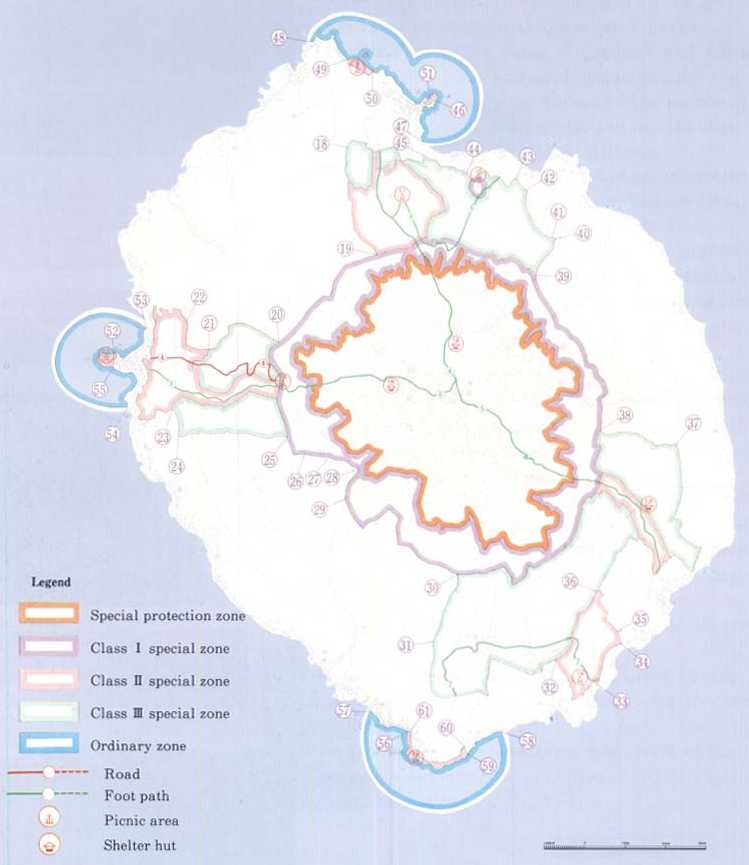
- Example of National Park Plan : Rishiri Island, Rishiri-Rebun-Sarobetsu National Park
[Policies & Program] Nature Conservation in Japan
5.Natural Park
5.3 Planning
Regulations for the National Parks protection and development of facilities for their utilization are planned by the Environment Agency. The plans are revised about every five years. For Quasi-National Parks, planning is elaborated by the related prefectures under the guidance of the Environment Agency to follow the standards of National Parks.
(1) For Conservation
Japan has been one of the densely populated countries. Most part of the national land, except for high mountain areas, religiously important areas and inappropriate lands for cultivation, have been utilized for many types of peoples' economic activities. Almost all private landowners occupy only small plots of land. If any national parks were designated, many economic activities had already been undertaken within the park sites.
Thus, areas designated as National Parks cover not only state-owned lands (most of which are national forests) and local government-owned lands, but also many privately owned lands. At presents, 24% of the whole national park areas, mainly located in western part of Japan and coastal areas, are private-owned lands.
Several activities such as agriculture, forestry and tourism & recreational industries can also be undertaken within the park areas. Management measures to regulate inappropriate development activities are always taken into consideration through the zoning system by the Environment Agency.
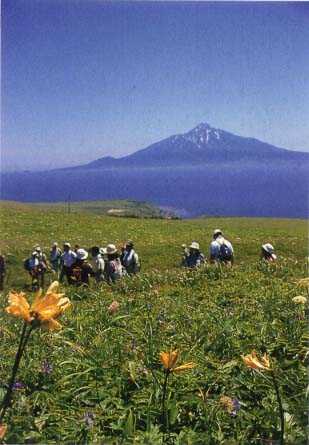
Rishiri Island
(Rishiri-Rebun-Sarobetsu National Park)
All park areas are classified into four zones: the special protection zone, the marine park zone, special zone and the ordinary zone according to natural grades of ecosystems and scenic beauty, degree of human impact to the natural environment, and also of importance for visitors use.
The following map illustrates an example of national park conservation and utilization plan of Rishiri Island, Rishiri-Rebun-Sarobetsu National Park close to northernmost main island, Hokkaido.
(2) For Visitor Use
Utilization plan is to facilitate appropriate access to and within parks and accommodation for park visitors. The plan includes how to arrange the exclusive "town site" so as to concentrate park accommodations in limited areas, and also how to arrange facilities required for traffic system, lodging and camping, nature observation, and other outdoor activities.
[Policies & Program] Nature Conservation in Japan
5.Natural Park
5.4 Nature Conservation in Natural Parks
(1) Control of Various Human Activities
To conserve outstanding scenic beauty and ecosystems, many activities liable to deteriorate natural environment are prohibited without prior permissions and licenses from the Director General of the Environment Agency or the Governor of the prefectural government concerned. With reference to the ordinary area, large-scale activities have to be notified in advance to the management authorities.
Permissions are issued in accordance with the "Guideline to Assess on Various Development Activities in National Parks Areas" elaborated by the Environment Agency. Summary of the Guideline is attached to this edition.
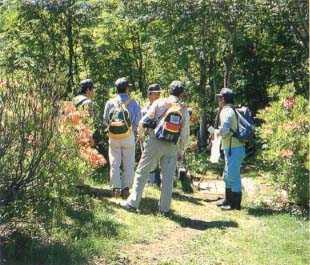
Beautification Activities
(2) Beautification Programs
To promote and encourage the beautification and cleaning in popular and key areas in the parks where many visitors visit, voluntary groups consisting of local governments, concessionaires, scientists, local peoples and others have been established and organized.
In order to encourage various beautification activities undertaken by more than 40 groups established, one quarter of necessary budget for their programs has been subsidized by the Environment Agency, one quarter by prefectural governments, and one quarter by municipality authorities concerned, and one quarter by local businesses concerned.
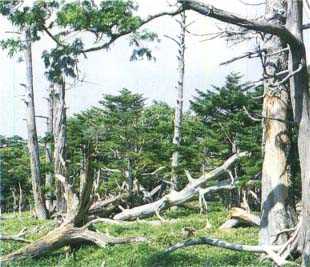
Purchase of privately owned lands in Odaigahara
(Yoshino Kumano National Park)
(3) Purchase of Privately Owned Lands
Japanese natural park system regulates the activities within the parks, which entail adverse effects on the natural environment and resources. The landowners, who could not acquire permissions or licenses, may receive compensation from the government. One way of compensation is to purchase the privately owned lands within national parks areas. It also serves to strengthen management of the park.
The policy to purchase important areas such as those in special protection zone and the Class I special zone was started in 1972 for national parks and in 1976 for the quasi-national parks. From 1991, this concept was expanded to the Class II and III special zones.
Such purchase was carried out by means of public bonds issued by prefectural governments. The funds for redeeming these bonds were subsidized by the national government. A total area of 6,507 ha was purchased by the prefectural governments and total amount of bonds issued reached to l2.34 billion yen by the end of March 1995.
[Policies & Program] Nature Conservation in Japan
5.Natural Park
5.5 Visitor Use and Provision of Facilities
(1) Numbers of Visitors to Natural Parks
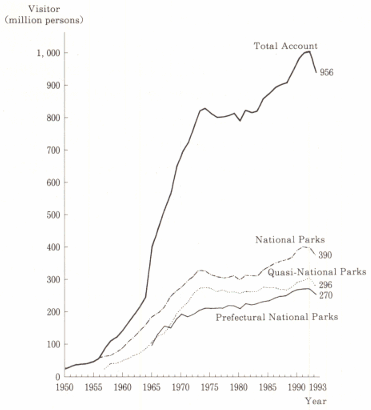
The number of visitors shows a tendency to increase gradually in recent years. They visit natural parks to enjoy the scenic beauty, through driving, mountain-climbing, hiking, camping, outdoor activities for nature observation, hot-spring-bath use, recreation, and so on.
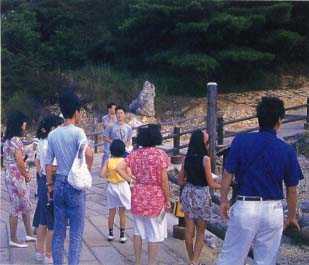
The number of Natural Park visitors in 1992 was as follows
Number of Visitors to Natural Parks
(Note)
For Quasi-National Parks, the Visitor Census was started in 1957. And, for Prefectural National Parks, it was started in 1965.
(2) Provision of Facilities
To promote the utilization of natural parks, licenses and/or permissions for the provision of facilities are granted to local public bodies and private bodies in compliance with the utilization plans of natural parks.
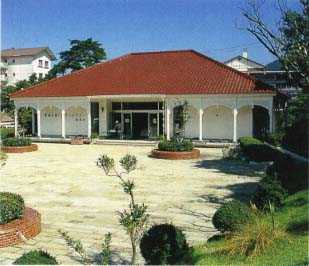
Visitor's center
(Unzen-Amakusa National Park)
(3) Provision of Public Facilities
In order to protect natural parks in a reasonable manner and enable people to safely and comfortably use them in response to the people's desire to commune with nature, provision of the following facilities that do not undermine the quality of nature is promoted.
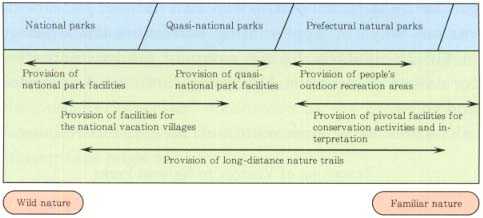
Public facilities are provided by the Environment Agency and by prefectures with assistance of the Environment Agency (subsidiary rate: 1/2 or 1/3) under the following policies and facility types.
National and quasi-national parks feature the excellent natural environment, picnic sites, nature trails, camping sites, visitors' centers, lavatories and other facilities provided in order to promote their safe and comfortable utilization in response to people's calls for communion with nature.
The budget for 1995 is as follows:
| Expense borne directly by the Environment Agency | ¥3,119 million |
| Subsidy (including the expense for long-distance nature trail) | ¥5,372 million |
| Total | ¥8,491 million |
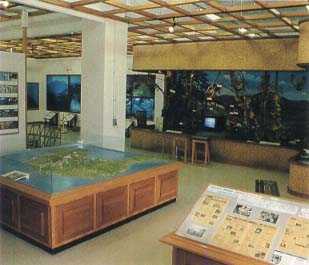
Exhibition
(Unzen-Amakusa National Park)
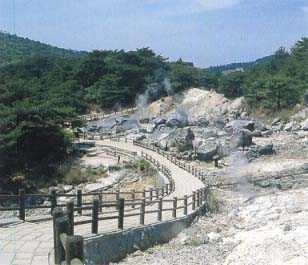
Nature trail
(Unzen-Amakusa National Park)
(4) Provision of Facilities by Concessionaires
In accordance with the Natural Parks Law, private bodies can get license to operate hotels, inns, skiing grounds and other accommodations for visitors from the Environment Agency in national parks and the prefectural governors in quasi-national parks. The license will be issued according to parks' scheme for visitor use as well as quality of accommodations and their management qualifications. This licensing scheme has contributed the local economic development and provided a number of job opportunities to the local people. License to the municipal governments has also been issued in many national parks.
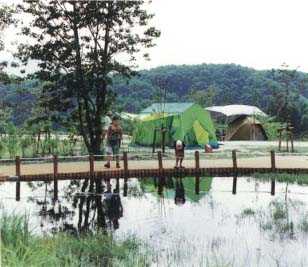
Camping ground
(Hiruzen National Vacation Village)
(5) National Vacation Village
National Vacation Villages are established at the places suitable for recreation within National Parks or Quasi-National Parks where natural environment is excellent. In the Villages, comfortable, clean and inexpensive lodging facilities, as well as other facilities for outdoor activities are provided and well organized.
Since the establishment of the first Villages in 1961, 34 Villages have been established and well managed.
Not-for-profit public facilities such as picnic sites, trails, camping sites, etc. among the facilities of National Vacation Villages, are arranged by the Environment Agency or local public bodies. On the other hand, commercial facilities such as hotels, lodges, skiers' lifts, etc., are provided and operated by the National Vacation Village Association.
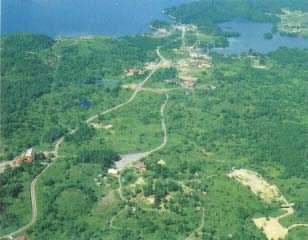
Urabandai National Vacation Village
[Policies & Program] Nature Conservation in Japan
5.Natural Park
5.6 Promotion of Contact with Nature
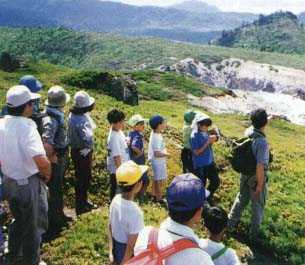
Interpretive service
To promote appropriate utilization of the natural resources, and to meet increasing desire of people for contact with nature, various guidance services are provided at visitor centers and other information providing facilities. Particularly in the best seasons, many programs are offered. For example, during the Campaign Period for Communicating with Nature, which starts on July 21 and ends on August 20 every year, various programs such as guided walks, slide shows, camping tour for children are held in most natural parks. To promote such activities, the Environment Agency is developing an annual training course for park staff who provides guidance services.
In order to encourage and utilize people's voluntary support and services in natural parks, the Park Volunteer Programs have been carried out since 1986. By the end of 1994, 30 areas of 21 National Parks have these programs. Under the programs, about 1,500 volunteers are participating in various activities for the parks, such as guidance and other services for visitors, maintenance of the park, research, etc. in accordance with the plan each National Park Office has developed. Besides, 3,000 people who are qualified to provide advice, instructions, guidance and other services for park visitors are commissioned to be Natural Park Leaders by the Agency to encourage and facilitate appropriate use of the parks. The Agency provides orientation and training seminars every year not only for the Park Volunteers but also for the newly commissioned Natural Park Leaders.
[Policies & Program] Nature Conservation in Japan
5.Natural Park
5.7 Administrative System
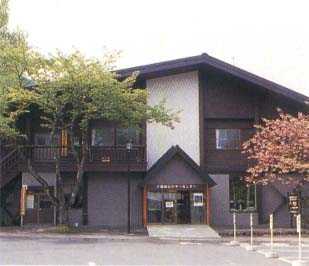
Touhoku area National Park and Wildlife Office
Management of the national parks system in Japan is carried out by the Environment Agency in close cooperation with prefectural governments, municipal authorities as well as land owners and private sectors. There are 55 Ranger Stations under 11 National Park and Wildlife Offices.
Management of quasi-national parks and prefectural natural parks is implemented by the related prefectural governors.
Enforcement of the Natural Parks Law in national parks is undertaken by the national park rangers and other park staff members and the local government officials in collaboration with landowners and private sectors.
Ministry of the Environment Government of Japan