Click here to search for Verified technologies
Non-metallic element wastewater treatment technology (boron wastewater treatment technology, hereinafter referred to simply as nonmetallic element wastewater treatment technology), which is the target of environmental technology demonstration projects, refers to hot spring wastewater from inns, plating, metal processing, etc. Wastewater treatment technology (equipment, etc.) that properly treats boron contained in plating wastewater. Of these, it is intended for low-cost, compact, easy-to-maintain technologies that are commercially available.
[Non-metallic element wastewater treatment technology]
- Boron is a non-metallic element that does not exist in nature alone, but forms boron compounds such as borax and boric acid. In the environment, it is contained in river water, groundwater, seawater, and soil, and is present in relatively high concentrations, especially in hot spring water. Boron compounds are also used in metal surface treatment, plating, glass production, and ceramic glaze production. Therefore, among boron discharged into public water areas excluding sea areas, naturally derived boron is mainly used for hot spring water, and artificially derived boron is mainly used in electroplating and enamel glaze manufacturing industries. It comes from things.
- Boron has been reported in cases of high-concentration intake and has been observed in animal experiments, and there are concerns about its effects on the human body. For this reason, it is designated as a water quality environmental standard health item based on the Basic Environment Law, and a water quality standard monitoring item based on the Water Supply Act. In addition, it is designated as one of the Class I Designated Chemical Substances in the “Act on Understanding, etc. Emissions of Specific Chemical Substances to the Environment and Promoting Improvements in Management” (The PRTR Law). The
- There is uniform drainage regulation based on the Water Pollution Control Law for wastewater from factories, business sites, etc., but for some industries with many small and small businesses, provisional drainage standards with loose regulation values are used. Setting. Control of boron emissions has been achieved to some extent by implementing wastewater regulations, but wastewater from small business sites that are subject to provisional wastewater standards cannot be ignored. Even these small businesses are expected to reduce emissions by introducing low-cost, compact, and easy-to-maintain technologies that can be introduced.
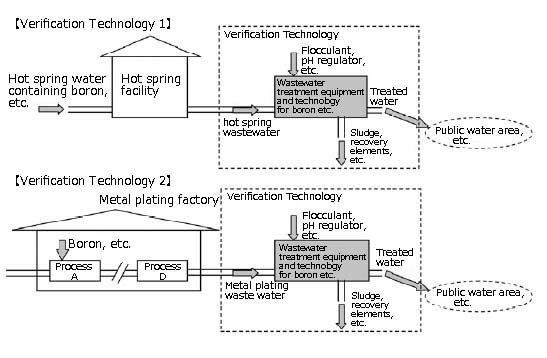
* Wastewater treatment technology can be broadly divided into two types: one for natural boron-containing wastewater discharged from hot spring facilities and one for artificial boron-containing wastewater discharged from plating plants. There are types.