Heat pump air conditioning system using geothermal heat

Click here to search for Verified technologies
Overview of subject areas
Technical overview
This technology uses the temperature difference between geothermal heat, sewage, etc. and the outside air to cool and heat the house. Underground (groundwater) has the characteristics that it is warmer than the outside air in winter and cooler than the outside air in summer, so it can cool and heat more efficiently than using air as a heat source. Also, in summer, it has a feature that it does not release exhaust heat during cooling into the air.
Examples of target technologies
Water-cooled heat pump that uses geothermal heat, sewage, etc. as a heat source, underground heat exchanger, and the entire system that combines them
* Demonstration tests are carried out with the following set of technologies (validation units).
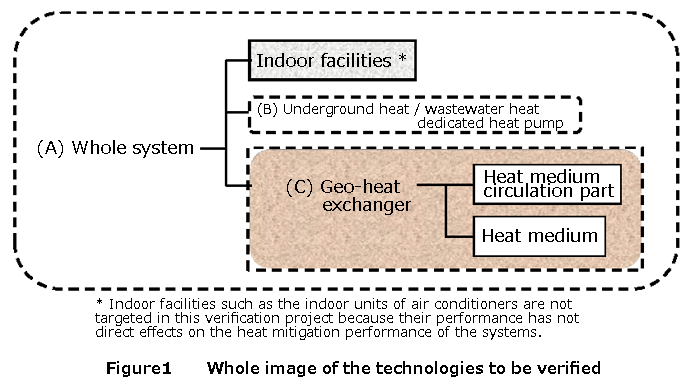
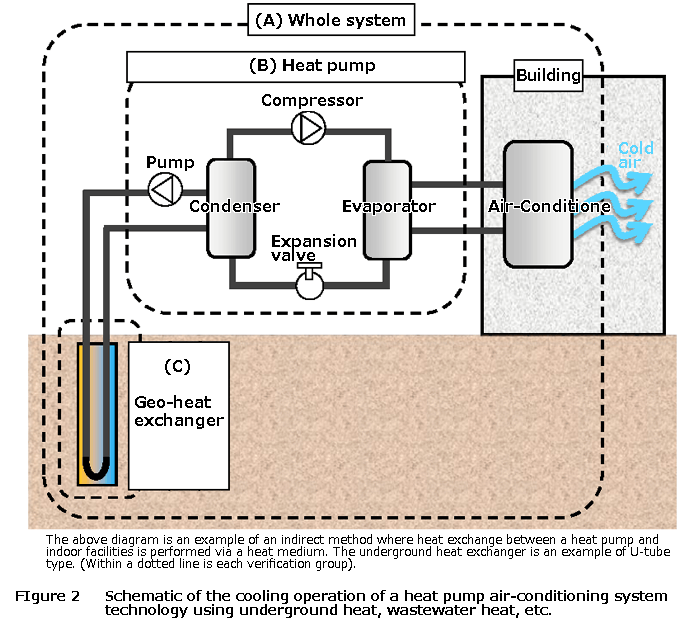
The purpose of this verification is to demonstrate the effectiveness of heat island suppression, so we mainly measure the amount of heat exchange between the system and the ground, and the energy efficiency of the system. Therefore, we will conduct a verification test with the unit (unit) of technologies (A) to (C) shown in Fig. 2. This unit is defined as “demonstration unit”.
In addition, if the structure of the underground heat exchange part is not suitable for the verification test as in the sewage heat utilization system, only items that can be verified, such as verification units (A) and (B), will be the verification items.
(A) The entire geothermal heat utilization system
This refers to the entire technology related to this system, from the heat exchange well to the indoor equipment system.
(B) Geothermal / sewage heat pump
This refers to a water-cooled heat pump that is assumed to be used in the temperature range of underground or sewage.
(C) Underground heat exchanger
The system from the underground heat exchange well to the front of the heat pump system.
Reference materials
To users (offices, schools / public facilities, hospitals / heat bath facilities / accommodation facilities, housing, agricultural facilities, road snow melting, etc. owners / owners)
Heat pump air-conditioning systems that use geothermal heat and sewage do not release artificial exhaust heat into the outside air, but exhaust it into the ground heat and sewage, leading to heat island suppression in summer. In addition, because it can perform cooling and heating more efficiently than using air as a heat source, it can also be expected to reduce carbon dioxide emissions and reduce running costs.
In the ETV business, paying attention to the “heat island countermeasure effect” among these effects, publicize the results of third-party technology demonstration tests on system energy efficiency, heat exchange performance with the ground, etc., and judge the effectiveness of the technology. By providing various information necessary to do this, we believe it will be useful for selecting technologies that meet the needs of users.
To Applicants for the demonstration (introducing water-cooled heat pumps that use geothermal heat, sewage heat, etc., ground heat exchange units, and systems that combine them, manufacturers, installers, sales operators, or those Companies / individuals)
In a questionnaire survey conducted by the Ministry of the Environment for private businesses involved in building construction and local governments nationwide, private businesses and local governments have some awareness of heat pump air conditioning systems using geothermal heat and sewage. , There were situations where general owners (customers) were thought to be less aware. There are also complaints about the ease of searching for related companies when trying to introduce them.
The ETV business provides users with an overview of environmental technologies that can be used, publishes the results of technology demonstration tests by third parties, and provides various information necessary for the user's technology selection. , We believe that it will help potential users to expand the spread of useful technologies for proof applicants.
In fact, in the questionnaire survey targeting past applicants for the verification, the response was “Inquiry about technology increased after the verification”, “There was some effect on activities such as sales promotion and technology development,” In addition, regarding the issued ETV logo mark, there is a reply that it is “published in product brochures, technical reports, external booklets, company websites, etc.”.
Background and related information
About heat pump air conditioning system using geothermal heat and sewageThis technology uses the temperature difference between groundwater (geothermal) and outside air to heat and cool the house. Groundwater has the characteristics that it is warmer than the open air in winter and cooler than the open air in summer, so it can cool and heat more efficiently than using air as a heat source. Also, in summer, it has a feature that it does not release exhaust heat during cooling into the air. And it has the feature that it helps to reduce artificial exhaust heat in the following two points.
- In summer, exhaust heat from the outdoor unit is not released into the air like an air-cooled heat pump (general cooling) that exchanges heat with the outside air, but is discharged into the ground, reducing the heat exhausted to the outside air. Will be.
- Heat pump air-conditioning systems that use geothermal heat can perform cooling and heating more efficiently than using air as a heat source, reducing the amount of exhaust heat to the outside air as energy is saved.
What is the heat island phenomenon?The heat island phenomenon is a phenomenon in which the temperature in the center of a city becomes higher in the shape of an island than in the suburbs. There are the following two main factors.
- Increased artificial heat exhaust from human activities such as air conditioning systems, electrical equipment, and automobiles
- It is caused by the artificialization of the ground surface due to the decrease in green space, water surface, and increase in buildings and pavement surfaces.
Nowadays, the heat island phenomenon has become widely recognized as an environmental problem unique to cities. In the Ministry of the Environment, about 50% of the heat (sensible heat to the air) affecting the temperature rise in Tokyo's 23 wards is due to artificial exhaust heat, and the exhaust heat generated by buildings such as air conditioning is It is estimated that it accounts for about half of that.
Furthermore, due to the heat island phenomenon and global warming, the urban thermal environment is getting worse, and improving the thermal environment in the city is an urgent issue. Artificial exhaust heat generated from offices and homes in particular is the main cause of temperature rise in large cities.
Reference: What is Heat Island Countermeasures?The Heat Island Countermeasures Charter formulated in March 2004 is the basic policy and the specific measures to be implemented in order to appropriately promote the efforts of the national, local governments, businesses and residents regarding heat island countermeasures. Are systematically compiled. There are four pillars of countermeasures: [1] reduction of artificial exhaust heat, [2] improvement of ground surface covering, [3] improvement of urban form, and [4] improvement of lifestyle. The revision was made in May 2013, and [5] Promotion of adaptation measures to reduce the impact on human health was newly added.